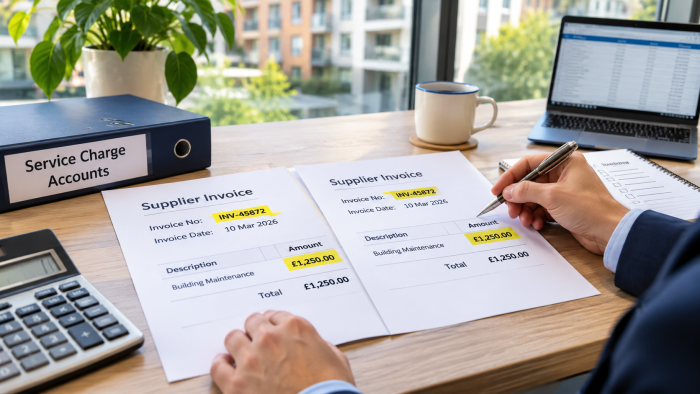
Duplicate invoices in service charge accounts can lead to overpayments, inaccurate financial reports and unnecessary disputes with leaseholders. To identify them, you should compare supplier names, invoice references, payment amounts and service dates, then reconcile the results against bank transactions and supplier statements. If you find a duplicate, the correction depends on whether the invoice has been recorded, approved or paid. Acting promptly helps protect service charge funds and ensures your accounts reflect genuine property expenditure.
For managing agents, landlords and property management companies handling multiple buildings, duplicate invoices can be particularly difficult to detect.
An invoice might appear in different accounting periods, be allocated to the wrong property or be submitted through several channels.
Understanding where these errors occur is the starting point for preventing them.
Why duplicate supplier invoices occur in service charge accounts
Duplicate invoices usually arise from administrative errors, inconsistent processing or weaknesses in financial controls.
Property management businesses can be particularly exposed because contractors frequently provide services across several buildings.
Need Expert Accounting Advice?
If you are unsure about tax, bookkeeping, payroll, property accounts or business finances, speak to the team at FHP Accounting for clear, practical guidance.
For example, a cleaning contractor might submit an invoice directly to a managing agent and separately send another copy to the finance department.
If each recipient processes the document independently, the same expense could be recorded twice.
Other common causes include:
- Repeated Invoice Submissions: Suppliers Resend Unpaid Invoices Without Clearly Marking Them As Copies.
- Multiple Invoice Channels: Documents Arrive Through Email, Supplier Portals And Accounting Software.
- Incorrect Property Allocation: The Same Expense Is Recorded Against Different Buildings Or Service Charge Schedules.
- Inconsistent Supplier Records: Different Names Or References Are Used For The Same Contractor.
- Manual Data Entry Errors: Invoice Numbers, Dates Or Amounts Are Entered Incorrectly.
- Poor Approval Controls: Payments Are Authorised Without Checking Existing Transactions.
These problems become harder to identify when the same finance team manages dozens of properties.
Maintaining accurate records through professional bookkeeping services can help you identify discrepancies before they affect financial reporting.
How to identify duplicate invoices in service charge accounts
The most reliable approach is to compare invoice details across your accounting records and investigate transactions that share similar characteristics.
You should not rely exclusively on matching invoice numbers. Suppliers sometimes change invoice references when resending documents, meaning duplicate transactions can appear different.
A structured review should examine the following information.
| Information to check | Warning signs | Recommended action |
|---|---|---|
| Supplier name | Similar invoices under different supplier records | Compare supplier details |
| Invoice number | Identical or slightly different references | Review original documents |
| Invoice amount | Repeated charges for identical amounts | Check service descriptions |
| Invoice date | Similar invoices issued close together | Confirm billing periods |
| Property reference | Same expense allocated to different buildings | Verify property allocation |
| Payment reference | Multiple payments against the same invoice | Reconcile bank transactions |
| Service period | Repeated charges covering identical work | Check contractor records |
An identical amount does not automatically mean an invoice is duplicated.
For example, a maintenance contractor might legitimately charge £450 every month for scheduled work.
The important distinction is whether the invoices represent separate services or the same work being charged twice.
Compare supplier invoices against bank transactions
Start by reviewing your purchase ledger and matching approved invoices against bank payments.
Look for payments with identical amounts, similar dates or matching supplier references.
Pay particular attention to payments made outside the normal payment process.
A supplier might receive payment through an automated bank transaction and later be included in a manual payment run.
Both payments could be legitimate entries in your banking records, even though only 1 invoice should have been paid.
Check invoices across different properties
For managing agents handling multiple buildings, checking each property’s accounts individually might not identify every duplicate.
Imagine a contractor completes electrical maintenance at a commercial building in Nottingham.
The contractor submits an invoice for £1,200, which is recorded against Building A.
A second copy arrives with an incorrect property reference and is entered against Building B.
Unless you compare supplier records across the property portfolio, the duplication may remain unnoticed.
A portfolio-wide supplier review can identify these discrepancies while maintaining separate accounting records for each property.
How to correct duplicate supplier invoices
Once you confirm a duplicate invoice, you should identify its accounting status before making changes. An unpaid duplicate may require cancellation or reversal, while a duplicate payment may require a supplier refund or credit. You must also check whether the error affects VAT records, service charge allocations or accounts already issued to leaseholders.
1. Correct an unpaid duplicate invoice
If the invoice has been entered but not paid, review the original document and confirm which transaction is valid.
Cancel, void or reverse the duplicate using the appropriate accounting procedure.
Retain supporting evidence explaining why the entry was corrected.
Avoid deleting transaction history unnecessarily, particularly where the records form part of an established audit trail.
2. Recover a duplicate supplier payment
If both invoices have been paid, contact the supplier promptly.
Provide the invoice references, payment dates and amounts involved.
Request a refund or an appropriate supplier credit, making sure it is allocated to the correct property’s funds.
For example, if a contractor receives 2 payments of £750 for the same repair, the overpayment is £750.
The recovery should be recorded against the property that funded the duplicate payment.
3. Correct the accounting records
Once the duplicate has been confirmed, update the relevant purchase ledger, supplier balance and service charge expense account.
The correct entries depend on the original transaction and whether the supplier has refunded the money.
If the duplicate affected VAT reporting, review the relevant return before making adjustments.
HMRC provides guidance on correcting VAT return errors. The appropriate method depends on the circumstances and value of the error.
Professional VAT return services can help ensure corrections are reflected appropriately in your VAT records, where applicable.
What happens if duplicate invoices are discovered after year-end accounts are prepared?
Duplicate invoices discovered after year-end reporting require careful treatment because the expense may already have affected service charge expenditure, tenant contributions or balancing adjustments.
First, determine whether the duplicate was simply recorded or actually paid.
Next, establish whether the accounts have been approved and distributed.
If the error is material, you may need to amend the service charge statement and explain the correction to affected parties. The appropriate treatment depends on the lease, reporting framework and circumstances.
For commercial properties, the RICS service charges in commercial property professional standard provides requirements and guidance on transparency, reporting and service charge expenditure.
You should also consider whether previously calculated tenant balances need adjusting.
Where duplicate transactions affect a property’s financial position, support with annual statutory accounts may be relevant to the management company, although statutory company accounts and service charge accounts serve different reporting purposes.
How accounting software can help prevent duplicate invoices
Accounting software can make duplicate invoice detection more manageable, particularly when your organisation processes large volumes of supplier payments.
For example, Xero includes duplicate bill detection functionality that can alert users when potentially matching bills are identified.
However, automated warnings should support financial controls rather than replace them.
Software may not reliably identify an invoice recorded against another property, under a different supplier name or with an altered reference.
A reliable process still requires someone to review supporting documents and confirm whether the expense is genuine.
Using Xero bookkeeping services can help you maintain accurate supplier records, reconcile payments and improve the consistency of financial reporting.
Practical controls to prevent duplicate payments
Preventing duplicate invoices is generally easier than recovering payments after they have been made.
Your property management business should establish a consistent process for receiving, approving and paying invoices.
Useful controls include:
- Centralised Invoice Processing: Direct All Supplier Invoices Through An Agreed Submission Channel.
- Unique Supplier Records: Maintain Consistent Supplier Names And Reference Details.
- Invoice Approval Checks: Verify Work Completed Before Authorising Payment.
- Duplicate Payment Reviews: Check Existing Transactions Before Every Payment Run.
- Regular Bank Reconciliation: Match Payments Against Approved Supplier Invoices.
- Separate Approval Responsibilities: Where Practical, Use Different People To Process And Authorise Payments.
- Monthly Supplier Reconciliation: Compare Supplier Statements With Outstanding Invoices And Recorded Payments.
It is also worth investigating why errors occurred instead of simply correcting individual transactions.
If duplicates repeatedly arise because invoices arrive through multiple channels, improving the submission process could prevent future problems.
For organisations with limited internal accounting resources, an outsourced finance department can support supplier management, invoice processing and routine financial controls.
Frequently asked questions
Can duplicate invoices affect service charge contributions?
Yes. Duplicate invoices can overstate service charge expenditure and potentially affect the amounts attributed to leaseholders or tenants. The impact depends on whether the duplicate was recorded, paid and included in the final accounts. Once identified, you should correct the expenditure and review any affected service charge calculations.
Can accounting software automatically detect every duplicate invoice?
No. Accounting software can identify many potential duplicates, especially invoices with matching references and amounts. However, differences in supplier names, invoice numbers, property allocations or service descriptions can prevent automatic detection. Regular reconciliations and manual reviews remain important for identifying more complicated errors.
How often should managing agents check for duplicate invoices?
You should check invoices before approving payments and review supplier transactions during monthly reconciliations. Larger property portfolios may benefit from more frequent checks. A detailed review before preparing annual service charge accounts can also help identify errors that routine payment controls have missed.
Keep your service charge accounts accurate with FHP Accounting
Duplicate supplier invoices might seem like minor administrative mistakes, but their consequences can extend beyond the original payment.
They can distort expenditure reports, complicate reconciliations and create avoidable questions from leaseholders.
At FHP Accounting, we provide specialist accounting support for landlords, commercial property managers and property management companies in Nottingham and across the UK.
Our services include service charge accounting, bookkeeping, supplier reconciliation and financial reporting.
If you need help reviewing your service charge accounts or improving your invoice processing procedures, contact FHP Accounting to discuss your requirements.
Call 0115 648 8686 or email theteam@fhpaccounting.co.uk to arrange a consultation.

I lead FHP Accounting, an accountancy practice specialising in Commercial and Residential Property Accounting. Our goal is to make the administration of running property portfolios easier for landlords, managers, and investors — allowing you to focus on what you do best, while we take care of everything behind the scenes.
Need Expert Accounting Advice?
If you are unsure about tax, bookkeeping, payroll, property accounts or business finances, speak to the team at FHP Accounting for clear, practical guidance.